What a Float Tank Really Does: A Guide to Sensory Deprivation
Floating isn't a fancy bath. Removing every sensory input puts your brain in a state it almost never reaches-here's what's happening, why it's so hard the first time, and what to expect by session three.
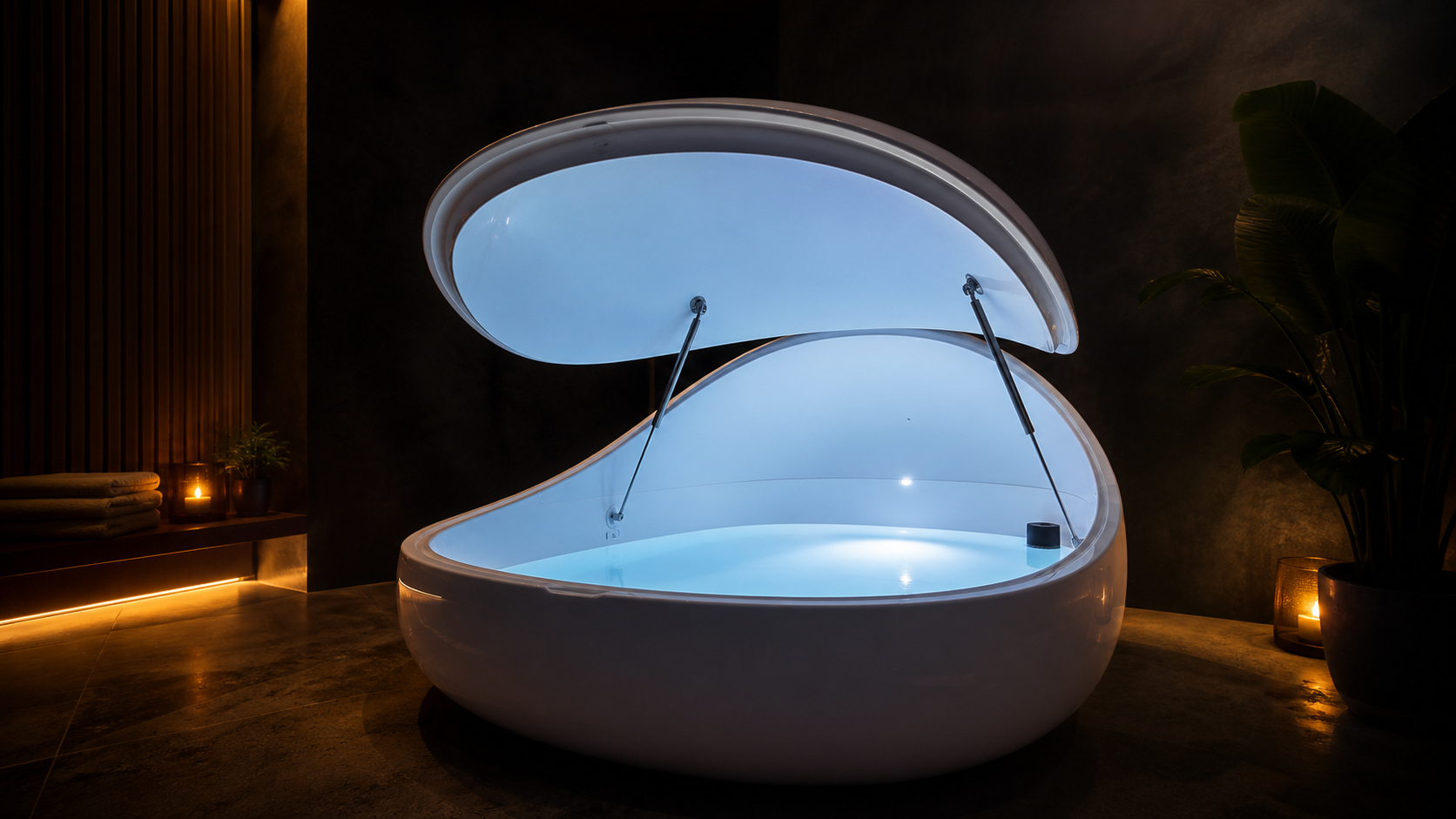
Close the lid on a float pod and within ten minutes you’ll notice something unexpected. It’s loud in there. Not outside noise. Your noise. Tomorrow’s meeting, the conversation you didn’t finish, the thought you’ve been putting off.
If your first session was harder than you expected, you weren’t doing it wrong. Float therapy is a specific neurological intervention, and your brain takes time to accept that it doesn’t need to stay on.
The Mechanics
A float pod holds about ten inches of water saturated with around a thousand pounds of medical-grade Epsom salt. The water sits at skin temperature, roughly 93.5 to 95°F. The room is dark. The lid closes, or stays open if you prefer. Sound is muffled or absent.
You lie on the surface, held up entirely by the salt. You cannot sink.
Within minutes, your brain loses track of its usual inputs:
- Gravity disappears. Your spine, joints, and pressure points stop sending the low-level signals they normally send.
- Temperature signals fade. Your skin can’t distinguish water from air.
- Vision ends. Eyes open or closed, there’s nothing to see.
- Sound ends. Even your own movements are muffled by water.
- Proprioception fades. Your brain stops tracking where your limbs are.
Your nervous system normally processes thousands of inputs per second. In a float tank, it has almost nothing to process.
What Actually Happens to Your Brain
Functional MRI and EEG studies on people in float tanks show several things:
Brain wave shift toward theta states. Theta waves sit between awake and asleep. Monks reach theta in deep meditation; most adults only touch it for a few seconds at sleep onset. Floaters drop into theta within 20-30 minutes. With practice, faster.
Default mode network quiets. This network runs your background self-narrative: the running monologue, the worry loop, the to-do list. With nothing to react to, it goes quiet.
Cortisol drops measurably. Pre- and post-session cortisol levels show consistent reductions. Your body reads total sensory silence as safety.
Endorphin release increases. Magnesium absorption from the Epsom salt contributes, but the bigger driver is the parasympathetic shift.
Floaters reach for words like dissolved, weightless, gone. They’re describing a brain that stopped waiting for the next input.
Why the First Float Is Often Hard
Most floaters hit rough patches their first session.
The first ten minutes are loud. Without external noise, your internal noise fills the space. Tomorrow’s meeting. The conversation you didn’t finish. The thought you’ve been avoiding. All of it surfaces.
Your body holds tension you didn’t know was there. Without gravity to anchor your shoulders, they often stay braced. Your neck, lower back, or jaw works for no reason.
You start wondering if it’s working. You ask whether you’re doing it right, whether you should feel something specific, whether the timer is broken. That questioning is what keeps you from settling.
Quieting takes time. For many people, the first session never fully gets there. Members have told us their third session was when they finally understood what the experience was supposed to be.
What to Expect by Session Three
By visit three, you know what’s coming. The first few minutes go faster. Your shoulders drop without effort. Your mind settles sooner.
Members who float regularly describe:
- Sleep getting noticeably deeper
- Anxiety baseline dropping
- Recovery from physical training accelerating
- Creative thinking sharpening
- Decisions feeling less effortful
One float is a useful experience. A dozen over a few months changes your baseline.
Who Floats and Why
A few patterns we see:
The overstimulated knowledge worker. Eight hours of Slack, Zoom, and notifications. For those eight hours, every input was an alert. The float pod is the only hour without one.
The athlete. Magnesium absorption supports muscle recovery, and floating after training accelerates recovery to baseline faster than passive rest alone.
The chronic-pain patient. Removing gravity takes pressure off compressed joints, herniated discs, and tight fascia. Many people with back pain leave their first float surprised by how quiet their body became.
The high-anxiety mind. Float is the most reliable nervous-system reset we offer. Members with anxiety often pair it with sauna or salt room work.
The creative. Writers, designers, founders, musicians. Theta states are where ideas emerge. Several of our regulars float to break through creative blocks.
How to Make Your First Float Easier
Don’t go in tired or hungry. Floating amplifies whatever state you bring. Exhausted, you’ll just sleep. Hungry, your stomach will take over.
Do it after a workout, not before. Post-training, your adrenaline is spent and your body wants to recover. Floating then is more useful than almost anything else you could do.
Skip caffeine for at least four hours beforehand. Stimulants and floating work against each other.
Try 20 minutes of infrared sauna before your first float. It loosens your body and takes the edge off your nervous system. Most first-timers find the combination easier than walking in cold.
Leave the lid open if you want. The pod lid is optional. We have open float rooms with no enclosure. Sensory deprivation doesn’t require an enclosed space.
Show up. Lie there. Let the timer end. If it feels like nothing’s happening, you’re probably closer than you think.
How It Stacks With Our Protocols
Float anchors our Nervous System Drop: Float, then Salt Room, then Infrared Sauna. Float first, then move to the salt room and sauna while your system is already down. Members use this sequence for chronic stress, racing minds, and recovery from high-output weeks.
Float also pairs well with hyperbaric oxygen on the same day. The cellular work of HBOT and the nervous-system work of floating run in parallel.
Common Questions
How long is a session? Sixty minutes for first-timers. We have 90-minute and 120-minute options for experienced floaters.
Will I fall asleep? Maybe. Many people do, especially their first few visits. You still absorb magnesium, your muscles recover, and the parasympathetic shift happens either way. The deeper conscious states require staying just barely awake. With practice, you learn to hold there.
What if I’m claustrophobic? Lid stays open, or book one of our open float rooms with no enclosure. Tell us before your visit and we’ll set up whichever works.
Can I drown? No. The salt makes sinking physically impossible. If you flip onto your stomach in your sleep, the salt water in your face wakes you immediately.
Will I be cold? The water is heated to skin temperature. After 10-15 minutes you can’t feel the boundary between water and air. Our pods maintain this precisely.
How often should I float? Once a week is the sweet spot for most people. Every two weeks if budget is a factor. Once a month maintains the benefit; less than that and accessing the state takes longer each time.
The Bottom Line
Your nervous system processes thousands of inputs per second every waking hour. Floating removes nearly all of them at once. The brain state that follows takes time to reach, and the first session often doesn’t get there fully.
Session three is usually where it clicks. Regular practice builds on itself. Book a float or try the Nervous System Drop to start.
We're a Tampa Bay family passionate about recovery and wellness. We built Rest Recovery to share the modalities that have transformed our own health.
Get More Wellness Tips
Subscribe to get the latest recovery insights delivered to your inbox.
Continue Reading
Cryotherapy vs Cold Plunge for Recovery
Cryotherapy vs cold plunge: which actually helps you recover? Here's how whole-body cryo and cold water immersion differ on cold exposure, cost, and results, and which one is worth your time in Tampa.
Hyperbaric Oxygen for Brain Health and Longevity
Beyond the athlete use case-how hyperbaric oxygen therapy supports neuroplasticity, cognitive function, post-concussion recovery, and the long game of aging well.
The Contrast Stack: Why Recovery Sauna + Cold Plunge Beat Either Alone
Heat alone helps. Cold alone helps. Cycling between them does something neither can do solo-and it's the foundation of how we build resilience.